
Contextual Link Building Services
Backlinks placed within content that matches relevancy signals – exactly what Google wants to see.
✔️ We build contextual assets to attract links
✔️ No paid schemes, link farms or footprint risk
✔️ Topically relevant, editorial content
✔️ Real websites, real traffic, real authority (editorial, DR 50+)
Schedule a 15min Intro
Unlike traditional link building (irrelevant and non-contextual), our links sit inside a paragraph of relevant content — surrounded by topically related text — which is the #1 signal in Google’s algorithm.
The 2 best ways to earn contextual link placements:
Research and Data Assets
Original industry data (related to your product/service) is one of the most consistently linked-to assets on the web. Journalists need statistics. Bloggers need citations. AI writing tools pull from credible sources. We build data-driven research pieces, optimized to appear when writers look for something worth citing — which results in contextual links placed editorially, inside relevant articles, on high-authority domains.
High-Value Web Tools
Interactive calculators, templates, and utilities earn contextual links because they solve specific problems (that writers want to point their readers toward). A well-designed tool gets mentioned inside articles naturally — the author explains a concept, then links your tool as a practical resource. That in-content placement is a textbook contextual backlink.
Some of the contextual assets we’ve built for websites:
These websites couldn’t afford $300 per link. So we built contextual “link assets” that attract & earn links naturally.
Contextual vs. Standard Link Building
| Contextual | Standard | |
|---|---|---|
| Relevance | Every link sits inside topically related content — reinforcing the exact relevancy signals Google weighs most heavily | Placements are frequently inserted into unrelated pages purely for link purposes, a pattern search engines have become skilled at identifying and discounting |
| Editorial Legitimacy | Links are placed because a writer or publisher found your asset genuinely worth referencing — no transaction involved | Placements exist because money changed hands, not because content merited a citation — Google's quality systems treat this distinction very seriously |
| Domain Quality | Real publishers with genuine audiences and organic traffic — sites that wouldn't accept payment for a link even if offered | Often link marketplaces or low-quality sites operating behind a veneer of legitimacy, with inflated or fabricated authority metrics |
| Google Risk | Zero exposure to manual penalties or algorithmic devaluation — editorially earned links are exactly what Google wants to reward | Moderate-to-high risk of devaluation, deindexing, or lasting search visibility damage as detection systems improve |
| Longevity | Editorial contextual links tend to remain permanently — and the assets that earned them keep attracting additional placements over time | Links frequently disappear when contracts expire or sites get penalized, requiring constant monitoring and replacement spend |
| Cost Trajectory | Per-link cost decreases over time as existing assets accumulate new placements without additional spend | Fixed cost per link indefinitely — no compounding return, no passive accumulation, no reduction in per-link cost |
| Anchor Text Profile | Naturally varied anchor distribution that reads as genuinely earned to both Google and modern LLM-based search systems | Tends toward over-optimized, exact-match anchors that trigger spam filters or get algorithmically ignored |
| Reporting | Full transparency — confirmed placements, real domain metrics, verified traffic data | Reporting is frequently unreliable, with manipulated metrics, undisclosed link removals, or misrepresented domain quality |
| Bottom Line | A compounding authority advantage built on links that strengthen rankings over years — not months | Short-term gains that demand continuous budget to sustain, with growing exposure to penalty risk as algorithms advance |
Contextual link building isn't instant. Assets need to get indexed, build search visibility, and work their way into the research and writing workflows of publishers in your space. Here's how the timeline typically unfolds:
Here’s a graph of what this looks like over time:
Between Month 3-6, the contextual backlinks beat standard backlinks – and continue attracting links on autopilot for $0 (while standard methods keeps costing you $200-500 per link… misery.)
Between Month 3-6, our contextual backlinks beat standard backlinks – and continue attracting links on autopilot for $0 (while standard methods keeps costing you $200-500 per link… misery.)
Contextual Link Pricing
Starter
- Industry insights / data reports
- Embedded web tools
- Contextually-earned
- Zero penalty risk
- Editorial placements only
- Natural anchor text distribution
- Detailed monthly reporting
Growth
- Industry insights / data reports
- Embedded web tools
- Contextually-earned
- Zero penalty risk
- Editorial placements only
- Natural anchor text distribution
- Detailed monthly reporting
Scale
- Industry insights / data reports
- Embedded web tools
- Contextually-earned
- Zero penalty risk
- Editorial placements only
- Natural anchor text distribution
- Detailed monthly reporting
Enterprise
- Industry insights / data reports
- Embedded web tools
- Contextually-earned
- Zero penalty risk
- Editorial placements only
- Natural anchor text distribution
- Detailed monthly reporting
OUR LINK PERFORMANCE GUARANTEE:
(This only applies to under-performance. This doesn’t happen often – our success rate is fairly high.)
Do you see the intersection point in the graph above? That point typically happens after 3-6 months.
If you don’t acquire an average of 1 DR 30+ contextual link per asset by month 8, we’ll ramp-up and accelerate your link magnets to hit 1 link per asset by month 12 (without charging you more).
These extra link magnets will be delivered to you within 30 days after month 8, allowing plenty of time to achieve that mark by month 12. And keep in mind – contextual link assets keep generating links EVEN AFTER we stop working together. Standard link building SEO companies can never give you that, they charge per link. It’s impossible.
FAQs:
Can I cancel anytime?
Yes, there are no locked contracts. We go month-by-month with zero setup fees.
Why does the surrounding text matter for a backlink, making it contextual?
For many years, link builders used to manipulate ONLY anchor text (to match the keywords they wanted to rank for). Google started evaluating the anchor + surrounding text to get a better understanding of the link, since the anchor text alone isn’t a good-enough signal.
Can you guarantee the number of links we earn?
Our guarantee above outlines the minimum # of links we guarantee, although we typically achieve more than that.
How long will it take to start earning contextual links?
There’s a ramp-up period of 3-6 months, although we can typically get at least a few links within the first 1-2 months. After 3-6 months, you are vastly out-performing all standard methods of link building.
How "effective" are the links, compared to standard/paid link building?
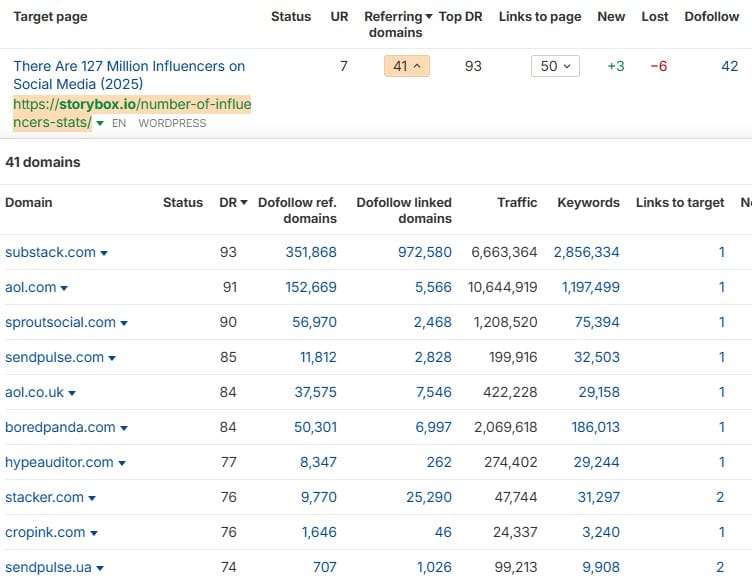
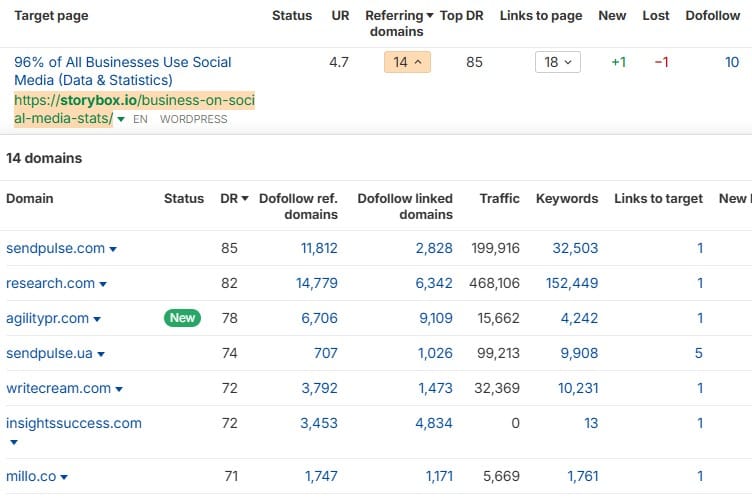
These are the most difficult, valuable and authoritative “in-article” editorial links – from strong companies and news outlets.
Check the 2 example screenshots above.
Those are high-authority websites that transfer a large amount of link equity to your website. In fact, you literally can’t even buy a link from many of those companies. You have to EARN them naturally.
Will links continue to come in, after we stop working together?
YES, this is the powerful aspect of 100% contextual link building. These assets keep generating links EVEN AFTER we stop working together (expect a slow decline over 2-4 years).
If this works so well, then why doesn't everyone else do it?
1) Many industry leaders already do it. Some of these link magnets pull-in a huge number of contextual links naturally, it’s almost hard to believe.
2) To answer your question: For 95% of standard link building agencies, it’s very difficult to convince businesses to invest in something speculative, without strict defined outcomes (number of contextual links). Most businesses aren’t willing to wait a bit longer. They often ditch the effort after 1-2 months. Rome was not built in 1-2 months.